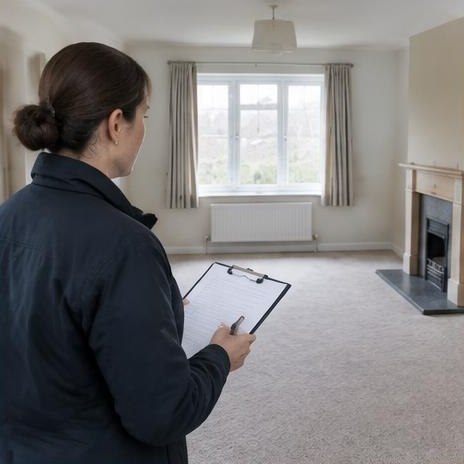
Assessment means reviewing the property and requirements before agreeing work. In hoarding clearance, it is a practical process for understanding the proposed scope, access, belongings, working arrangements and matters needing further enquiry. It is not a judgement about the person or a diagnosis. A useful assessment distinguishes what has been seen, what has been reported and what remains uncertain, so that any proposal reflects the available information rather than assumptions about the home.
Establishing the purpose of the review
An assessment should begin with what the person wants to achieve. The goal might be access to one room, preparation for a move or removal of a defined group of items. Without that starting point, a provider may describe a much broader task than the person intended.
For example, someone might request help making a dining table available again, rather than clearing the entire dining room. The assessment should explore what is involved in that goal without quietly replacing it with a room-wide removal plan.
Ask the provider how they record the requested outcome and distinguish essential work from optional suggestions. The conversation can also identify what the person does not want included. These exclusions are practical information, not obstacles to be overcome. A proposal is easier to evaluate when it clearly connects each suggested task to the agreed purpose of the visit.
Choosing the assessment format
An assessment may begin with a conversation, photographs, a video call or an in-person visit. Each format provides different information and has limitations. Ask why the provider recommends a particular approach and whether the resulting quotation or plan will remain provisional.
For example, photographs may show the amount of material in a room but omit a narrow staircase or an entrance behind the camera. A remote review should not imply that these unseen features have been checked. The record can identify them as questions for a later visit.
Privacy should be part of choosing the format. Ask which images are needed, how personal details can be kept out of view and how submitted material will be used and retained. A resident who does not want to share photographs can ask what alternatives exist. The provider can then explain any limits those alternatives place on the accuracy of the initial proposal.
Ready to discuss your clearance? Request a free quote or call us to talk through your requirements.
Recording areas viewed and not viewed
A property assessment is only as complete as the areas that can be considered appropriately. Locked rooms, restricted routes and concealed features may leave significant gaps. Those gaps should be recorded plainly rather than absorbed into a general description of the whole property.
For example, if the assessor sees the hall and kitchen but cannot view the upstairs rooms, a room-by-room record can state that distinction. Any estimate for the upper floor should identify the basis used, such as the resident's description, and the need for later confirmation.
Ask whether the written assessment separates direct observations from information supplied by others. This matters when relatives have different recollections or when conditions have changed since photographs were taken. It also protects the resident from being treated as though every unknown detail was something they should have anticipated. An honest account of uncertainty supports more realistic decisions about the next stage.
Understanding belongings and decision requirements
Volume alone does not describe the work. The assessment should consider how belongings will be identified, who makes decisions and which categories need individual review. A room containing many already approved removals may require a different process from a smaller area containing documents, photographs and shared possessions.
For example, a cupboard of labelled household supplies might be straightforward to discuss, while one drawer contains papers belonging to several family members. The assessment should recognise that difference rather than estimating decision time solely from the amount of space occupied.
Ask how retained, undecided and approved items will be distinguished. Also discuss any items the person particularly wants found, such as identification documents or a specific keepsake. The provider should explain how such requests affect the proposed method without promising that a missing item will be located. Ownership questions should be recorded for resolution rather than settled by assumption during the visit.
Asking about safety and specialist input
An assessment can identify matters that require further review, but it should not be represented as covering every possible technical concern. Ask what the assessor is considering, what falls outside their service and when another suitable professional may be needed.
For example, a provider might encounter a damaged appliance or an area where the condition of the floor is uncertain. The useful questions concern how work would be paused, who would assess the issue and how the resulting advice would affect the plan. The resident should not be asked to test uncertain conditions themselves.
Ask whether the provider's proposal includes any assumptions about utilities, access equipment or specialist handling. If those assumptions cannot yet be confirmed, they should remain visible in the written record. This is more useful than broad reassurance, because it explains which parts of the plan can be agreed now and which depend on further information.
Including communication and personal preferences
The assessment should consider how the person wants the work discussed and organised. Preferences about who attends, how many decisions are presented at once, and whether a supporter is involved can materially affect the service. These are practical requirements, not merely background details.
For example, a resident may prefer one point of contact because repeated explanations to several workers are tiring. Ask whether that arrangement is possible and how instructions will be shared within the team without requiring the person to repeat private information.
The assessment can also establish the preferred pace, pause arrangements and boundaries around rooms or categories of belongings. A supporter may offer useful information, but their account should not automatically replace the resident's own preferences. Where there are conflicting instructions or uncertainty about permissions, ask how the provider will resolve that uncertainty and whether appropriate professional advice is needed before work is agreed.
Turning findings into an agreed proposal
The assessment should lead to information that can be checked, not merely a verbal impression. A useful proposal identifies the scope, exclusions, assumptions, proposed approach and any matters awaiting confirmation. It should explain how changes will be handled if the property or requirements differ from the assessment.
For example, the initial visit might support a proposal for two accessible rooms while leaving a storage area outside the quotation. The written record should make that boundary obvious, rather than describing the booking simply as a property clearance.
Ask which findings influence staffing, scheduling and the quotation. Also ask whether the person can correct factual errors before accepting the proposal. If a formal property process affects the work, seek advice on applicable permissions and arrangements instead of assuming that the assessment establishes legal authority. Its purpose is to inform agreement about a service, not to decide ownership disputes or settle unrelated professional questions.