Belongings are items that belong to a person and require decisions before removal. In hoarding clearance, the term recognises that objects have owners, uses and personal meanings, even when their purpose is not immediately apparent to someone else. Belongings can include everyday equipment, clothing, documents, collections and keepsakes. Discussing them as possessions helps keep the process focused on individual decisions rather than assuming that an item's location, condition or apparent value determines whether it should leave.
Establishing who owns an item
Ownership may seem obvious in a single-person household, but belongings can be borrowed, stored for relatives or shared with others. Identifying those distinctions helps prevent a removal decision being made by someone who does not regard the item as theirs to decide about.
For example, a sewing machine in a spare room might belong to a sibling who left it there years earlier. The resident may want the space available but still need to resolve the item's ownership before deciding its destination. Ask the provider how such items will be recorded and kept outside agreed removals while that question is considered.
Where ownership is disputed or connected with an estate, separation or rented property, seek appropriate professional advice about applicable permissions. A clearance provider should not be expected to settle the dispute. The practical task is to identify the uncertainty and avoid treating physical possession as a complete answer.
Distinguishing value from appearance
A belonging's significance may be practical, financial, historical or personal. These forms of value do not always coincide. A worn notebook may matter more to its owner than an expensive appliance, while an ordinary-looking object may need specialist appraisal before a destination is agreed.
For example, a resident may want to retain a chipped cup because it was used by a close friend. The decision does not require the provider to share that preference or establish a market value. It requires an accurate record that the cup is staying.
Ask how potentially valuable or personally important items will be brought to the person's attention. If valuation is needed, discuss an appropriate independent professional rather than assuming the clearance team can provide it. Equally, avoid promises that valuable objects will be found. A careful process can recognise uncertainty without turning the person's belongings into a speculative search for saleable items.
Ready to discuss your clearance? Request a free quote or call us to talk through your requirements.
Giving decisions a clear status
Belongings need a decision status that everyone understands. Useful distinctions include retained, awaiting review and approved for a specified destination. The language matters less than the consistency: an item awaiting review should not be treated as approved merely because it has been moved away from its original position.
For example, a box placed near the entrance might contain items the resident wants to examine later, not items ready to leave. Ask how the provider prevents location alone from becoming an instruction. Written lists, agreed labels or another accessible recording method may be appropriate, depending on the setting.
Decisions can also be conditional. Someone might agree that a table may go to a particular recipient but want another discussion if that recipient declines it. Ask how conditions are recorded and what happens when they cannot be met. A destination preference should not silently become permission for any alternative route.
Reviewing containers and grouped items
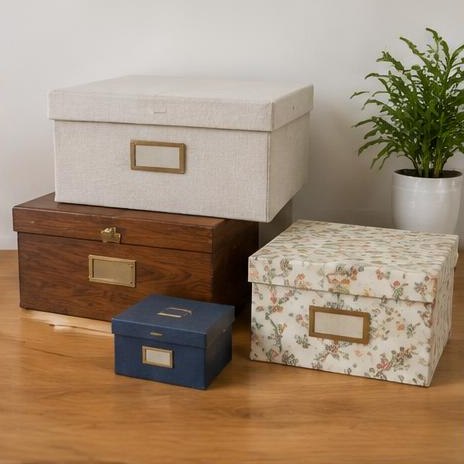
Boxes, bags, drawers and folders can contain belongings with very different meanings or owners. A decision about the container is not necessarily a decision about everything inside it. The agreed process should explain when contents are reviewed and when a person is comfortable making a group decision.
For example, a resident may approve a sealed box of unused envelopes as one group but want each item in a nearby folder considered separately. Both approaches can be valid if the person understands what is included and the provider follows the agreed distinction.
Ask what happens when unexpected contents appear. A packet of photographs inside a box of household supplies should trigger the agreed review process rather than automatically follow the surrounding items. The provider should also explain whether containers will be opened during the assessment or only during booked work, and how the person's privacy preferences will be respected at either stage.
Protecting documents and private information
Some belongings carry information as well as personal meaning. Letters, identity documents, financial records, photographs and digital devices may require a decision process that takes privacy into account. Their small size can make them easy to overlook if the work is organised only around large objects.
For example, a resident might ask for correspondence bearing family addresses to be set aside rather than included with other paper items. Ask the provider how such instructions will be communicated, what happens when documents are found unexpectedly and how any proposed onward handling is explained.
For digital equipment, ask whether data-related services are included or whether separate professional assistance is needed. Do not assume that removing a device also addresses the information stored on it. If there is uncertainty about keeping particular records, seek appropriate advice relevant to those records rather than relying on a general clearance rule or an invented retention period.
Keeping retained belongings identifiable
Deciding that an item stays is only useful if it remains identifiable throughout the work. Retained belongings may need temporary relocation, especially when they sit beside approved removals or along a working route. That movement should be discussed as a separate practical step.
For example, a set of family albums might be moved from a cabinet to another agreed room while the cabinet leaves. Ask how the provider records the albums' temporary location and confirms that the cabinet's removal does not include its contents. This is particularly important when several people are working.
Discuss how the person will find retained possessions afterwards. A simple location record may be more useful than a large collection of labels that the person cannot easily interpret. Ask whether the final review includes confirming where key belongings have been placed. The aim is continuity of ownership and access, not simply preventing an accidental removal during the session.
Confirming destinations before belongings leave
Removal is a change in a belonging's location and often its availability to the owner. Before that change, the agreed destination should be understood as far as practicable. Possible routes may include transfer to another person, storage, sale, donation, recycling or disposal, but not every provider offers every option.
For example, someone may approve books for donation on the assumption that a recipient has accepted them. Ask whether acceptance is confirmed and what happens if some books are declined. The resident may want a further decision rather than an automatic alternative.
Also ask about the point after which an item cannot realistically be retrieved. Do not rely on an assumption that anything can be recovered later. If the person changes their mind before departure, the provider should explain what can still be altered. Recording agreed destinations and any conditions makes the final review more precise than asking broadly whether everything is ready to go.